We provide fully independent advice and do not pay or receive referral fees from agents or third parties.

Get Your Survey Quote
Call us today to book a survey 01691 898560

Condensation within roof voids is commonly encountered in residential buildings where roof ventilation is inadequate in relation to internal moisture levels. The defect affects both traditional and modern dwellings with cold roof construction, particularly where insulation has been upgraded without corresponding improvements to ventilation. It is frequently associated with properties that are intermittently heated, have high internal moisture generation, or where ventilation pathways at eaves or ridge level are blocked or absent. In older buildings, the risk may be increased by later alterations that disrupt traditional air movement or introduce impermeable materials.
Poor roof ventilation is a well-recognised cause of condensation forming within loft spaces and roof voids. Warm, moisture-laden air from the dwelling below can migrate into the roof space, where it cools and condenses on colder surfaces such as roof coverings, underlays, and structural timbers.
If not adequately controlled, condensation can lead to timber decay, corrosion of fixings, deterioration of roof coverings, and reduced thermal performance. Understanding how roof ventilation should function, and how defects arise, is essential to diagnosing and addressing condensation-related issues effectively.
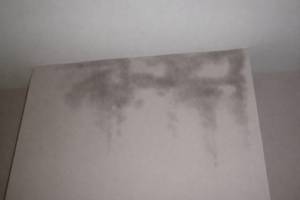
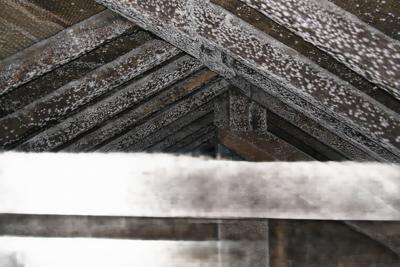
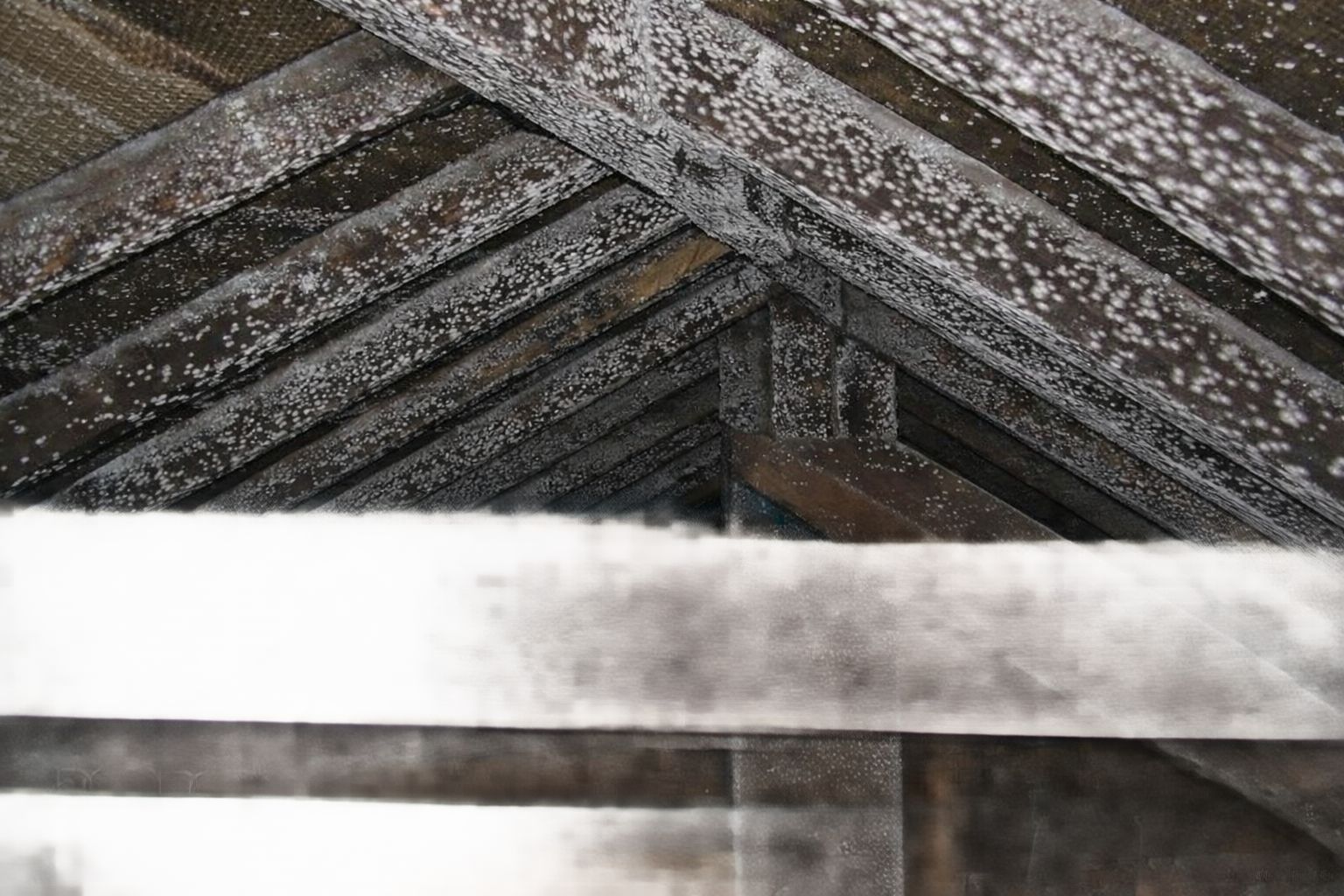
Condensation in lofts may present as visible water droplets on the underside of roof coverings or underlays, damp or stained timbers, and mould growth on rafters, sarking boards, or insulation surfaces.
In colder conditions, frost may form on the underside of roof coverings, subsequently melting and causing water staining or dripping. Insulation materials may appear damp or compressed, reducing their effectiveness.
A musty odour may be present within the loft, and metal fixings such as nails or straps may exhibit corrosion. In more advanced cases, signs of fungal decay may be observed in roof timbers.
Inspection should include safe access to the roof void to assess ventilation provision, insulation layout, and evidence of moisture accumulation. The presence, type, and condition of ventilation openings at eaves, ridge, or high-level points should be identified.
Common issues include blocked eaves vents due to insulation overfill, absence of cross-ventilation, or reliance on limited ventilation provision that is insufficient for the roof form and moisture load.
The condition of roof underlays should be examined, noting whether modern breathable membranes or older non-breathable felts are present. Penetrations for services, recessed lighting, and loft hatches should be assessed as potential pathways for moist air ingress.
Condensation in lofts typically arises due to an imbalance between moisture input and ventilation capacity. Key contributing mechanisms include:
When warm, moist air enters a cold roof void, condensation occurs as air cools below its dew point, depositing moisture on cold surfaces.
Persistent condensation can lead to decay of roof timbers, corrosion of metal components, and degradation of roof coverings and underlays. Damp insulation may lose effectiveness, increasing heat loss and exacerbating condensation risk.
In severe cases, moisture may drip back onto ceiling finishes, causing staining or damage internally. Long-term exposure to elevated moisture levels may compromise the structural integrity and durability of the roof structure.
In heritage buildings, inappropriate interventions may disrupt traditional moisture management and increase the risk of concealed fabric deterioration.
Remedial measures should address both moisture ingress and ventilation provision.
Improving roof ventilation may involve clearing blocked eaves vents, installing additional eaves or ridge ventilation, or providing cross-ventilation where absent. Care should be taken to ensure that insulation does not obstruct airflow pathways.
Reducing moisture ingress from the dwelling below is equally important. This may include sealing air leakage points, improving ceiling airtightness, upgrading loft hatches, and ensuring adequate extract ventilation to kitchens and bathrooms.
Any remedial works should be proportionate and compatible with the roof construction and materials.
Roof ventilation should be designed to suit the roof form, pitch, and covering, taking account of insulation levels and anticipated moisture loads. Cold roofs typically require continuous ventilation at eaves level and, in some cases, high-level ventilation to promote effective air movement.
Where breathable membranes are used, ventilation requirements may differ but should not be omitted without proper assessment. Detailing should ensure continuity of airflow and prevent blockage by insulation.
Traditional roofs often relied on natural ventilation through loosely fitted coverings and breathable materials. Later interventions, such as the introduction of impermeable underlays or tightly sealed ceilings, may disrupt this balance.
In heritage buildings, remedial strategies should aim to reinstate effective ventilation and breathability rather than rely solely on modern membranes or sealing measures. Minimal intervention and compatibility with original construction should be prioritised.
BRE Digest 110 – Condensation
Explains the causes of condensation in buildings, including surface and interstitial condensation, and outlines principles for diagnosis and control.
https://www.thenbs.com/PublicationIndex/documents/details?DocId=274030&Pub=BRE
BRE Digest 464 – Roof ventilation
Provides guidance on ventilation requirements for pitched roofs, including cold roof construction and prevention of condensation in roof voids.
https://www.thenbs.com/PublicationIndex/documents/details?DocId=285676&Pub=BRE
BRE Good Repair Guide 12 – Condensation and mould growth
Practical advice on identifying condensation-related defects and implementing appropriate remedial measures.
https://bregroup.com/store/bookshop/condensation-and-mould-growth
Approved Document C – Site Preparation and Resistance to Contaminants and Moisture
UK Building Regulations guidance covering moisture control, including condensation and resistance to moisture in roofs and building fabric.
https://www.gov.uk/government/publications/site-preparation-and-resistance-to-contaminates-and-moisture-approved-document-c